[New 2026] NCERT Class 6 English Poorvi Chapter 1 Question Answer A Bottle of Dew.


Posted
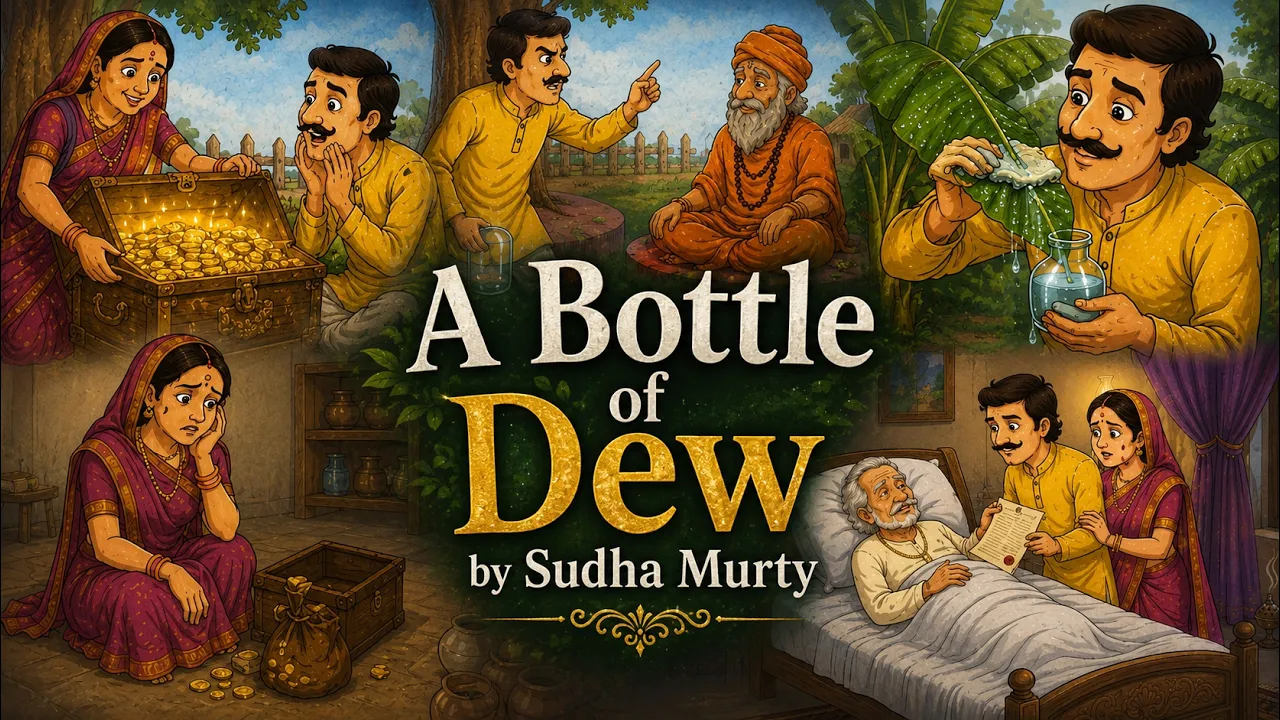
Access the best NCERT Solutions for Class 6 English Poorvi Unit 1 Fables and Folk Tales Chapter 1 A Bottle of Dew textbook exercise questions and answers. 'A Bottle of Dew' written by Sudha Murty is a story of a man 'Rama Natha' who believes in a magic potion that can turn any object into gold. To make that potion he spend most of his time and money. One day, A famous sage Mahipati taught him the importance of hard work and perseverance. He tricked Rama Natha by giving him a task of collecting 5 litres of morning dew from the leaves of banana plantation. It took 6 years of hard work and dedication of Rama Natha for collecting 5 litres of morning dew. But, at the end Rama Natha understood the wisdom behind the learning given by the sage Mahipati and after that he started working even harder on his banana plantation...

# A Bottle of Dew Class 6 story .
Listen to the Story 👇🏼

Rama Natha was the son of a rich landlord. His father left him large tracts of land when he died. But Rama Natha did not spend even one day looking after his land. This was because he had a funny idea—he believed there was a magic potion that could turn any object into gold. He spent all his time to learn more about this potion. People cheated him often, promising to tell him about it, but he did not give up. His wife, Madhumati, was tired of this and also worried because she saw how much money Rama Natha was spending. She was sure that soon they would be without money.
One day, a famous sage called Mahipati came to their town. Rama Natha became his follower and asked him about the potion. To his surprise the sage answered, “Yes, in my travels in the Himalayas, I heard how you could make such a potion. But it is difficult.”
“Tell me!” requested Rama Natha, not believing his luck.
“You have to plant a banana plant and water it regularly with your hands. In winter, the morning dew is on the leaves. You have to collect the dew and store it in a bottle. When you have five litres of dew, bring it to me. I will chant some magic words, which will turn it into the magic potion. A drop of the potion will change any object into gold.”
Rama Natha was worried. “But winter is only for a few months. It will take me years to collect five litres of dew.”
“You can plant as many banana plants as you want. But remember, you must look after them yourself and collect the dew with your own hands.”
Rama Natha went home, and after talking to his wife started cleaning his large fields, which had been lying empty all these years. There he planted rows and rows of banana plants. He tended them carefully and during the winter months collected the dew that formed on them with great care. His wife helped him too. Madhumati gathered the banana crop, took it to the market and got a good price for it. Over the years, Rama Natha planted more and more plants and they had a huge banana plantation. At the end of six years, he finally had his five litres of dew.

Carefully, he took the bottle to the sage. The sage smiled and muttered something over the water. Then he returned the bottle and said, “Try it out.” Rama Natha sprinkled a few drops on a copper vessel and waited for it to turn to gold. To his surprise nothing happened!
“This is cheating,” he told the sage. “I have wasted six precious years of my life.”
But sage Mahipati only smiled and called Madhumati to come forward. She came with a big box. When she opened it, inside shined stacks of gold coins!
Now the sage turned to the very surprised Rama Natha and said, “There is no magic potion that can turn things into gold. You worked hard on your land and created this plantation. While you looked after the trees, your wife sold the fruits in the market. That’s how you got this money. It was your hard work that created this wealth, not magic. If I had told you about this earlier, you would have not listened to me, so I have played a trick on you.”
Rama Natha understood the wisdom behind these words and worked even harder on his plantation from that day on.
By - Sudha Murty.
# A Bottle of Dew Class 6 Summary in English and Hindi
🏛️ A Bottle of Dew Class 6 Summary in English .
● Rama Natha, son of a rich landlord inherits a large piece of land. But, He believed in a magic potion that could change any objects into gold. To make that potion he spent most of his time and money. His wife Madhumati, was worried that if this continued then soon they would be without money.
● One day, a famous sage called Mahipati told Rama to plant banana plants in his field and collect 5 litres of morning dew from its leaves and bring it to him. so that he can chant some magic words to turn that dew into magic potion.
● Rama Natha went home and started cultivating banana plants. He looked after his plants and during winter months he collected the dew from its leaves.
● While Rama Natha was busy in collecting the dew, his wife Madhumati gathered the banana crop, took it to the market and got a good price for it.

● Over a period of six years, Rama Natha collected 5 litres of dew and he took the bottle to the sage. where sage chanted some magic words to turn that dew into magic potion and returned it to Rama to try it out. Rama Natha tried it on a copper vessel but nothing happened!. Rama Natha felt cheated and realised that he had wasted six precious years of his life.
● Sage told him that while he were busy in collecting the dew, his wife has sold the fruits in the market and earned gold coins which were stacked in a big box.
● It was Rama Natha's hard work that created the wealth, not magic. The Sage played a trick on him. so that he can learn that "There is no magic potion that can turn things into gold, it is just your hard work that can help you gain your wealth."
● Rama Natha understood the value of hard work and continued to work diligently on his plantation.
🎓 A Bottle of Dew Class 6 Summary in Hindi .
A bottle of dew Hindi translation
● एक अमीर ज़मींदार के बेटे रामा नाथ को विरासत में ज़मीन का एक बड़ा टुकड़ा मिला। लेकिन, उसे एक ऐसे जादुई घोल पर भरोसा था जो किसी भी चीज़ को सोने में बदल सकता था। उस घोल को बनाने में उसने अपना ज़्यादातर समय और पैसा खर्च कर दिया। उसकी पत्नी मधुमती को चिंता थी कि अगर ऐसा ही चलता रहा तो जल्द ही उनके पास पैसे नहीं बचेंगे।
● एक दिन, महीपति नाम के एक मशहूर साधु ने रामा से कहा कि वह अपने खेत में केले के पौधे लगाए और उनकी पत्तियों से 5 लीटर सुबह की ओस इकट्ठा करके उनके पास लाए, ताकि वे कुछ जादुई मंत्र पढ़कर उस ओस को जादुई घोल में बदल सकें।
● रामा नाथ घर गया और केले के पौधे उगाने लगा। उसने अपने पौधों की देखभाल की और सर्दियों के महीनों में उनकी पत्तियों से ओस इकट्ठा की।
● जब रामा नाथ ओस इकट्ठा करने में व्यस्त था, तब उसकी पत्नी मधुमती ने केले की फसल इकट्ठा की, उसे बाज़ार ले गई और उसके अच्छे दाम पाए।
● छह साल के दौरान, रामा नाथ ने 5 लीटर ओस इकट्ठा की और वह बोतल लेकर साधु के पास गया। साधु ने उस ओस को जादुई घोल में बदलने के लिए कुछ जादुई मंत्र पढ़े और उसे आज़माने के लिए रामा को वापस दे दिया। रामा नाथ ने उसे तांबे के बर्तन पर आज़माया, लेकिन कुछ नहीं हुआ! रामा नाथ को ठगा हुआ महसूस हुआ और उसे एहसास हुआ कि उसने अपनी ज़िंदगी के छह कीमती साल बर्बाद कर दिए थे।
● साधु ने उसे बताया कि जब वह ओस इकट्ठा करने में व्यस्त था, तब उसकी पत्नी ने बाज़ार में फल बेचे और सोने के सिक्के कमाए, जो एक बड़े बक्से में जमा किए गए थे।
● यह रामा नाथ की कड़ी मेहनत थी जिससे दौलत बनी, न कि जादू से। साधु ने उसके साथ एक चाल चली थी ताकि वह यह सीख सके कि "ऐसा कोई जादुई घोल नहीं है जो चीज़ों को सोने में बदल सके; सिर्फ़ आपकी कड़ी मेहनत ही आपको दौलत कमाने में मदद कर सकती है।"
● रामा नाथ को कड़ी मेहनत की अहमियत समझ आ गई और उसने अपने बागान में लगन से काम करना जारी रखा।
# Character Sketch :

● Wealthy
● Lazy
● Obsessive

● Practical
● Clever
● Supportive

● Extremely Wise
● Trickster
● A great Teacher
# A Bottle of Dew Word - Meanings :
- Large tracts of land : Large areas of land.
- Land lord : Owner of the land.
- Potion : A liquid with magical power.
- Give up : Stop trying.
- Worried : Concerned or troubled about actual or potential problem.
- Sage : A profoundly wise person.
- Town : A place which is smaller than a city but larger than a village.
- Dew : Small drops of water on leaves form during night.
- Chant : To repeat a word or phrase.
- Empty : Contains nothing.
- Planted : Cultivated (sown crop).
- Tended : looked after.
- Gathered : Collected.
- Crop : Plants that are grown on a large land.
- Plantation : Cultivation of crop.
- Muttered : Spoke in a low voice.
- Sprinkled : Sprayed/Scattered/Dispersed.
- Precious : Valuable.
- Stack : Pile/Heap/Bundle.
- Surprised : Shocked/Stunned/Alarmed.
- Wealth : Resources like money/property.
- Trick : Conspiracy/Deception/Misguided.
- Wisdom : Deep understanding.
# Literary Devices :
● Irony : The irony is that Rama Natha does become incredibly rich, but not from magic dew. He gets rich because his wife sold the bananas that he had grown to collect the dew.
● Metaphor : Sage Mahipati tells Rama Natha that there is a magical process to get rich, but the true "magic" is simply dedication and hard work.
● Imagery : Descriptions of - tending the plants, carefully collecting tiny drops of dew in the early winter mornings, and the sheer volume of "five liters of dew".
● Symbolism : The Magic Potion symbolizes human desire for quick, easy wealth and shortcuts in life.
# Moral of the story :
A Bottle of dew moral of the story
● Hard work, dedication and consistency are the true path to success.
● Shortcuts are often lead to disappointment.
● Wisdom lies in recognizing the true value of one's efforts.
# Flashcards : " Let's recall "


# NCERT Solutions :
Ncert class 6 english poorvi chapter 1 question answer a bottle of dew.
# Page 01 : Let us do these activities before we read.
Q1. Circle the picture that matches with each word. Check your answers by sharing them with your classmates and teacher.

Q2. Answer these questions and discuss them with your classmates and teacher.
(a) Think of a time when you worked hard. What did you do then?
Answer. I remember that I worked hard during my exam. I used to study whole day and also till late night so that I can score good marks in my exam.
(b) How did it help you?
Answer. It helped me understand the subject better and scoring good marks in my final examination.
(c) How did it make you feel?
Answer. It make me feel confident and mentally strong during my examination.
A bottle of dew class 6 question answer.
# Page 03 : Let us discuss.
Q1. What did Rama Natha believe?
Answer. Rama Natha believed that there was a magic potion that could turn any object into gold.
Q2. How did the sage help Rama Natha?
Answer. The sage helped Rama Natha by making him believe that he knows how to make the magic potion.
Q3. Do you think Rama Natha will be able to collect the dew? Give a reason.
Answer. Yes, Rama Natha will be able to collect the dew because he desperately wanted to make the magic potion.
A bottle of dew ncert class 6th english poorvi chapter 1 question answer.
# Page 05 : Let us discuss.
Q1. Why was Rama Natha angry?
Answer. Rama Natha was angry because the dew that he collected in 6 years did not work as a magic potion and all his hard work was wasted. So he felt cheated by the sage as he promised Rama Natha that he will turn the dew into a magic potion by chanting some magic words but he failed to do so.
Q2. How did Rama Natha and Madhumati create wealth?
Answer. Rama Natha and Madhumati create wealth from the banana plantation that they had grown on the large piece of land which was inherited by Rama after his father's death.
NCERT Solutions for Class 6 English Poorvi Unit 1 Fables and Folk Tales Chapter 1 A Bottle of Dew textbook exercise questions and answers.
# Page 06 : Let us think and reflect.
Q1. Read the following lines and then answer the questions that follow.
(a) He spent all his time to learn about the magic potion. People cheated him often, promising to tell him about it, but he did not give up. His wife, Madhumati, was tired of this and also worried because she saw how much money Rama Natha was spending. She was sure that soon they would be without money.
(i) Complete the sentence with a suitable reason.
Rama Natha did not ‘give up’ because he believed in the magic potion
(ii) Read the column which shows ‘what happened’ and write the correct outcome in the next column.
| What Happened | Outcome |
|---|---|
| A. People promised to tell Rama Natha about the magic potion. | He got cheated by the people. |
| B. Rama Natha was spending a lot of money. | He lost lot of money. |
(iii) Write whether the following statements are True or False.
a. Madhumati was troubled about what her husband did.( True )
b. Rama Natha was very happy digging his fields.( False )
c. The sage wanted to show the right path to Rama Natha.( True )
(b) Carefully, he took the bottle to the sage. The sage smiled and muttered something over the water. Then he returned the bottle and said, “Try it out.” Rama Natha sprinkled a few drops on a copper vessel and waited for it to turn to gold. To his surprise nothing happened!
(i) Choose the option that lists the events given below in the correct order.
a. The sage smiled.
b. Rama Natha gave the bottle to the sage.
c. Rama Natha dropped a few drops of water on a copper vessel.
d. He said something in a low voice over the water.
e. Rama Natha waited to see if the magic worked.
- 1. a, e, d, b, c ❌
- 2. b, a, d, c, e ✅
- 3. c, d, a, b, e ❌
- 4. a, d, b, e, c ❌
(ii) Fill in the blank with the correct word from the lines given above.
Seeing that the plant had dried up, the gardener Sprinkled some water on it.
(iii) How might Rama Natha have felt when nothing happened to the copper vessel?
Answer. Rama Natha might have felt cheated and disappointed when nothing happened to the copper vessel.
NCERT Solutions for Class 6 English Poorvi Chapter 1 A Bottle of Dew.
Q2. Answer the following questions.
(a) What did the sage ask Rama Natha to do to make the magic potion?
Answer. The sage asked Rama Natha to plant bananas plants and collect 5 liter of dew from the leaves in the winter morning. He would then turned the dew into the magic potion.
(b) Why did the sage ask Rama Natha to do everything himself?
Answer. The sage asked Rama Natha to do everything himself. So that he could learn the lesson of hard working.
(c) How could Rama Natha have a big banana plantation after six years?
Answer. Rama Natha planted rows and rows of banana plants. He tended them carefully and Over the years, it becomes a huge banana plantation.
(d) How did the sage make Rama Natha believe that there is no magic potion?
Answer. The sage made Rama Natha believed that there is no magic potion by giving him the task of collecting 5 litres of dew from banana plantation so that he could learn the lesson of hard working. and could understood that it was hard work that created this wealth, not magic potion.
(e) Fill in the ‘before’ and ‘after’ table about Rama Natha.
| What he did before meeting the sage | What he did after meeting the sage |
|---|---|
| (i) Searching for magic portion. | (i) Looked after his land. |
| (ii) Spent a lot of time and money for that portion. | (ii) Created wealth through banana plantation. |
A Bottle of Dew Question Answer Class 6 English Poorvi Chapter 1 NCERT Solutions
# Page 08 : Let us learn.
Q1. Read the following words from the story.
Use the words correctly to complete the paragraph given below. There are two extra words in the box that you do not need.
There was a farmer who had a huge coconut plantation. He worked hard and did not depend on luck . Every day was difficult but he did not give up. One day, a man bought a bag of coconuts from him, and promised to pay him the money the next day. Days passed and the man did not pay him anything. The farmer felt cheated . About two months later, he met the same man and asked him about his money. The man said, “Oh! I had forgotten. Now, I remember buying coconuts from you.” And he paid the money.
Q2. Read the words from the story in Column A. Read the new words in Column B. Complete the meanings of the words given in Column B. Meanings of some words are given.
| Column A | Column B | Meaning of the words in Column B |
|---|---|---|
| I | eye | An organ which help us to see. |
| your | you're | short form of 'you are'. |
| dew | due | happening at some time in future. |
| son | sun | The star around which earth revolves. |
| one | won | past tense of win. |
| ate | eight | A number which comes after 7. |
| see | sea | large salt water body. |
Q3. Choose four pairs of homophones from the table above, and for each pair write a sentence that uses both homophones in the same sentence. Check your answers by sharing them with your teacher and classmates. An example has been given below :
I ate eight bananas for breakfast today.
Answer :
1. I really wanted to see a sea with my own eyes.
2. My son shines like a sun shine.
3. One can won any battle with hard work and consistency.
4. Due to cold weather dew drops collected on the plants leaves.
Q4. Match the phrases in Column A with the phrases in Column B. Use the connecting words given in the middle column to make meaningful sentences.
| Column A | Connecting Words | Column B |
|---|---|---|
| The children submitted their work (When?) | because | the bell rang. |
| He did not want to try rock climbing (Why?) | before | there was a traffic jam. |
| The children ran towards the gate (When?) | as soon as | the deadline. |
| Nitin was late to school today (Why?) | as | of his fear of heights. |
Now, write the new sentences in your notebook.
Answer.
| Column A | Connecting Words | Column B |
|---|---|---|
| The children submitted their work (When?) | before | the deadline. |
| He did not want to try rock climbing (Why?) | because | of his fear of heights |
| The children ran towards the gate (When?) | as soon as | the bell rang. |
| Nitin was late to school today (Why?) | as | there was a traffic jam. |
Q5. Here are two sentences with letter ‘b’. Read them slowly the first time. As you read them a few more times, read them faster each time.
A big bunch of bananas was bought by Bunty bhaiya.
Answer. Classroom activity
A Bottle of Dew Question Answer Class 6 English.
# Page 10 : Let us listen.
You will listen to what Madhumati does with the bananas in her plantation. As you listen, number the events in the correct order in which they happen. Write the number in the box beside each event.
- TRANSCRIPT -
Madhumati is very happy as she has many big bags of bananas. Firstly, she visits her mother and gives her two dozen bananas. Secondly, she goes to the market to sell the bananas. Next, she meets her old friend Kalawati in the market. Then, she gifts Kalawati a dozen bananas. Later, she decides to go home as she has sold most of the bananas. After that, on the way home, she meets a little boy who is hungry and gives him two bananas. Lastly, she goes to her neighbor's house and gives them a bunch of bananas. She has a smile on her face as she goes home.
Listen to the Transcript 👇🏼
(a) Gives two bananas to a boy who is hungry. [ 6 ]
(b) Meets her friend Kalawati in the market. [ 3 ]
(c) Visits her mother and gives her two dozen bananas. [ 1 ]
(d) Chooses to go home as only some bananas were left. [ 5 ]
(e) Visits her neighbour and gifts them a bunch of bananas. [ 7 ]
(f) Gives twelve bananas to her friend. [ 4 ]
(g) Goes to the market to sell the bananas. [ 2 ]
A Bottle of Dew Class 6 Questions and Answers.
# Page 10 : Let us speak.
I. Read aloud the following words from the story.
All these words have the letter ‘s’ in them. But the sound of letter ‘s’ is not always the same.
- in sage and promising – the letter ‘s’ has a /s/ sound
- in wisdom – the letter ‘s’ has a /z/ sound
- in trees – the letter ‘s’ has a /z/ sound
- in surprise – the first letter ‘s’ has a /s/ sound and the second has a /z/sound
Now, speak each word clearly along with your teacher and classmates. Your teacher will now say some words. Listen carefully to the sound of ‘s’. Write the sound next to the word
Answer : Classroom Activity
II. Discuss the following questions with a partner. You may use the hints given in brackets while speaking.
(a) What does hard work mean to you?
(It means … / It is something … / Well, you see … /What I mean is …)
(b) Give three reasons why you think hard work is important.
(Firstly, I feel … because … / Secondly, I think … since … /Lastly, I believe … as … )
(c) Share three ideas you would give to someone who needs to work hard.
(To begin with, it is important that … /Next, you could … / Finally, I think you should … )
Answer : Classroom Activity
# Page 11 : Let us write.
Q1. Work in pairs to complete the description of a banana. You may take the help of the words given in brackets. Share your answers with your classmates and teacher.

Now, use the information given in the picture to write eight sentences about a banana. Share your responses with your classmates and teacher.
Answer :
01. I like to eat banana at breakfast.
02. It taste sweet and creamy.
03. It is very healthy because it is rich in vitamins and gives energy.
04. It helps to gain body weight and also good for skin.
05. Colour of its outer covering is yellow with some brown and black spots.
06. It smells fruity, sweet and fresh.
07. Its outer covering feels waxy or smooth on touch.
08. We should add banana in our breakfast or fruit salad.
Q2. On the basis of the story ‘A Bottle of Dew’ develop a script with dialogues and enact it with expressions. Present it in the assembly or your classroom.
Answer : Classroom Activity
# Page 12 : Let us explore.
Q1. Find out the varieties of bananas which are grown, cultivated and eaten in different parts of India.

01. Cavendish :

Cavendish bananas are grown in India, and are the most widely available banana in the country. They are grown in many states, including : Maharashtra, Tamil Nadu, Gujarat, Bihar, West Bengal, Andhra Pradesh. Cavendish bananas are a versatile fruit that can be eaten on their own, or used in cooking and smoothies. They have a bright yellow peel, creamy white flesh, and a mild sweetness.
02. Red banana :

They are grown in many states, including : Tamil Nadu, Kerala, Karnataka, Bihar, Andhra Pradesh. They have a reddish-purplish or maroon skin at the onset that becomes yellowish-orange as it ripens. The red bananas’ pinkish-orange flesh is softer and sweeter than most Cavendish varieties of yellow bananas. Besides eaten raw, whole, one can even chop and add them to fruit salads and other desserts. Red bananas are also toasted, fried, and baked. When it comes to nutrition, they rank higher than most yellow bananas, even having a longer shelf life.
03. Mysore bananas :

Mysore bananas are native to India and have been growing wild since ancient times. The variety's center of origin is thought to be in Southern India, and the fruits are commercially cultivated, grown in home gardens, and foraged from wild plants throughout Kerala, Tamil Nadu, Mysore and Chamarajanagar districts of Karnataka. These thin-skinned bananas are short and fat tasting sweet with touches of tanginess. Besides consumed raw, their unique flavor has made them occupy a prominent place in desserts.
04. Pisang Raja :

Pisang raja grown mostly in Kerala, Karnataka, Andhra Pradesh, Tamil Nadu. It is also known as apple banana. Yellow in colour with black spots when ripe, the banana has orange-red flesh, with a sweet, creamy, apple-like flavor and grainy texture. Besides consumed fresh, it is an excellent addition in fruit salads and even used to make pancakes and fritters.
05. Robusta banana :

It is a semi-tall variety, grown mostly in Tamil Nadu and some parts of Karnataka, Andhra Pradesh and Maharashtra. It is a high yielding and produces bunch of large size with well developed fruits. Robusta bananas are a semi-tall variety that are often used for cooking and processing because of their thick, fibrous peel. They are high in fiber, vitamins, and minerals, and are comparable to other varieties of bananas in terms of nutritional value.
# Quiz : " The Tale Trail "
Quiz - A Bottle of Dew.
Quiz Finished!

Want to Score More?
Get FREE! access to an interactive MCQ Test which includes 25 MCQ's, which will defenitely helps you to score more.
# FAQ's : Frequently Asked Questions .
🎓 Story & Plot Questions :
Q. What is the story of A Bottle of Dew?
"A Bottle of Dew" by Sudha Murty is a folktale about a rich but misguided man named Rama Natha who wastes his wealth searching for a magic potion to turn things into gold. A wise sage tricks him into working hard on a banana plantation for six years to collect dew for the potion. In the end, Rama Natha realizes that the real "magic" that created his new wealth was his own hard work, not a potion.
Q. What does the word "A Bottle of Dew" mean?
In the context of the story, "A Bottle of Dew" refers to the glass bottle filled with five liters of morning dew that Rama Natha spent six long years collecting from banana leaves, believing it was the secret ingredient for a magic potion.
Q. What does "dew" mean?
Dew refers to the tiny drops of water that form on cool surfaces outside (like grass or leaves) during the night, typically seen in the early morning.
Q. What is the summary of the story "A Bottle of Dew"?
Rama Natha, a wealthy landlord's son, neglects his estate to search for a magical potion that turns objects into gold. One day, Sage Mahipati tells Rama Natha he knows the potion's recipe but needs five liters of winter morning dew collected from banana leaves. Rama Natha plants a huge banana plantation and works tirelessly for six years to collect the dew. When Rama Natha finally brings the dew to the sage, the sage reveals there is no magic potion. Instead, he shows Rama Natha the heavy box of gold coins Madhumati earned from selling the bananas. Rama Natha finally understands that his hard work was the real magic.
Q. Can you summarize the story of "A Bottle of Dew"?
(Can you summarize the story of "A Bottle of Dew" in English?)
Rama Natha was son of a wealthy landlord, neglects his large piece of land in search of a magical potion that can turns objects into gold. Worried, his wife Madhumati watches him waste their money. One day, a wise sage (Mahipati) tells Rama Natha that he knows the potion's recipe but he needs five liters of morning dew collected from banana leaves to make that potion. Rama Natha plants a huge banana plantation and works tirelessly for six years to collect the dew. Meanwhile, his clever wife (Madhumati) sells the bananas in the market. When Rama Natha finally brings the dew to the sage, the sage revealed that there is no magic potion. Instead, he shows Rama Natha a heavy box of gold coins that Madhumati earned from selling the bananas. Rama Natha finally understands that his hard work was the real magic.
Q. What is the central theme of a bottle of dew?
The central theme is the value of dignity of labor and hard work. It highlights that practical effort and patience lead to success, whereas chasing shortcuts and superstitions leads to ruin.
Q. What is the moral of a bottle of dew?
(What is the moral of the story "A Bottle of Dew" class 6?)
(What is the moral of the story of Ramanatha?)
The moral of the story is that hard work is the real magic. There are no magical shortcuts to success or wealth; they can only be achieved through dedication, consistent effort, and practical thinking.
Q. What lesson do we learn from a bottle of dew?
(What do I learn from a bottle of dew?)
The lesson we learn from the story a bottle of dew is that there is no shortcut to success. The illusion (magic potion) will drain time, energy, and resources. Only reality (hard work) is the real magic and success can only be achieved through dedication, consistent effort, and practical thinking.
Q. What lesson does the story Bottle of Dew teach about reality and illusion?
The story teaches that illusions (like believing in magic potions or easy money) will drain your time, energy, and resources. Reality, on the other hand, requires facing facts and putting in actual, physical effort. When Rama Natha stopped chasing the illusion of magic and focused on the reality of farming, he became genuinely successful.
Q. What are the main learning objectives of the book "A Bottle of Dew"?
As a chapter in the Class 6 English curriculum, the main learning objectives are :
- To understand the importance of hard work and self-reliance over laziness and superstition.
- To develop reading comprehension and narrative tracking skills.
- To expand vocabulary (learning words like plantation, muttered, wealth, sage).
- To identify literary elements like character development (Rama Natha's transformation from lazy to hardworking) and the moral of a folktale.
🎭 Character Based Questions :
Q. Who was Rama Natha and what did he do for living?
(Whose son was Rama Natha?)
Rama Natha was the son of a rich landlord. Initially, he did not work for a living; instead, he wasted his time and money searching for a magic potion to get rich quickly.
Q. What did Rama Natha inherit from his father?
Rama Natha inherited a large piece of fertile land and significant wealth from his father.
Q. What funny idea did Ramanatha have?
(What did Rama Natha believe in?)
Rama Natha foolishly believed that there was a magic potion that could instantly turn any everyday object into pure gold.
Q. What did he do before meeting the sage?
(On what did Rama Natha spend time?)
Before meeting the sage, Rama Natha spent all his time and money listening to tricksters who cheats, and wandering holy men, trying to find the recipe for the magic potion.
Q. Why did Rama Natha neglect his inherited land?
(Why didn't Rama Natha look after his land?)
Rama Natha neglected his land because he was completely obsessed with the idea of finding the magic potion. He thought farming was unnecessary since he believed that he would soon be able to turn anything into gold with that magic potion.
Q. Why was Madhumati worried about Rama Natha?
Madhumati, his wife, was a practical woman. She was worried because Rama Natha was rapidly wasting all their inherited wealth on fake holy men (tricksters) and ignoring their land, which would eventually leave them poor.
Q. What did the sage say about the magic potion?
(What did the sage ask Rama to do?)
Sage Mahipati told Rama Natha that he knew the secret recipe for the magic potion. However, he told Rama Natha that the potion required exactly five liters of winter morning dew, specifically collected from the leaves of banana plants.
Q. How did the sage help Rama Natha?
The sage helped Rama Natha by tricking him. Instead of giving him a magical shortcut, the sage gave him a task that forced him to work hard in the fields, ultimately turning him into a successful farmer.
Q. Why did the sage ask Rama Natha to do everything himself?
The sage Mahipati wanted to teach Rama Natha the value of hard work. By making a rule that Rama Natha had to plant the banana trees, tend to them, and collect the dew with his own hands, the sage ensured that Rama Natha couldn't just pay a servant to do the labor.
Q. Do you think Ramanatha will be able to collect the dew?
(Why did Rama Natha not give up?)
Yes, he was able to collect it. He did not give up because his greed and obsession with getting the magic potion were so strong that they motivated him to endure six years of intense physical labor.
Q. How could Rama Natha have a big banana plantation after 6 (six) years?
Collecting five liters of tiny dew drops took a very long time. To collect the dew faster, Rama Natha kept clearing more land and planting more and more banana trees over the six years, resulting in a massive plantation.
Q. Why was Rama Natha angry?
Rama Natha was angry because after six years of hard work, the sage muttered a chant over the dew, dropped it on a copper vessel, and nothing happened. It did not turn into gold, making Rama Natha feel cheated.
Q. How did the sage make Rama Natha believe that there is no magic potion in short?
The sage called Madhumati and asked her to bring the box of wealth she had saved. The sage showed Rama Natha that the gold coins in the box came from selling the bananas, proving that hard work creates real wealth, not magic.
Q. How did Rama Natha create wealth?
(How did Rama Natha and Madhumati create wealth?)
They worked as a team without realizing it. Rama Natha created wealth by working hard to grow thousands of banana trees. Madhumati created wealth by secretly taking those bananas to the market, selling them, and saving the gold coins.
Q. What lesson did Rama Natha learn at the end?
(What did Rama Natha learn at the end?)
Rama Natha learned that there are no magical shortcuts in life. He realized that hard work, patience, and the dignity of labor are the real "magic" that brings prosperity and wealth.
Q. Who is the author of A Bottle of Dew Class 6?
The story is written by the famous Indian author Sudha Murty.
# Still have some Doubts ?

# Learn More :

| Class 6 | Ganita Prakash |
|---|---|
 |
Chapter 01 : Patterns in Mathematics. |
 |
Chapter 02 : Lines and Angles. |
 |
Chapter 03 : Number Play. |
 |
Chapter 04 : Data Handling and Presentation. |
 |
Chapter 05 : Prime Time. |
 |
Chapter 06 : Perimeter and Area. |
 |
Chapter 07 : Fractions |
 |
Chapter 08 : Playing with Constructions. |
 |
Chapter 09 : Symmetry. |
 |
Chapter 10 : The Other side of Zero. |

| Class 6 | Curiosity |
|---|---|
 |
Chapter 01 : The Wonderful World of Science |
 |
Chapter 02 : Diversity in the Living World |
 |
Chapter 03 : Mindful Eating: A Path to a Healthy Body |
 |
Chapter 04 : Exploring Magnets |
 |
Chapter 05 : Measurement of Length and Motion |
 |
Chapter 06 : Materials Around Us |
 |
Chapter 07 : Temperature and its Measurement |
 |
Chapter 08 : A Journey through States of Water |
 |
Chapter 09 : Methods of Separation in Everyday Life |
 |
Chapter 10 : Living Creatures: Exploring their Characteristics |
 |
Chapter 11 : Nature’s Treasures |
 |
Chapter 12 : Beyond Earth |

| Class 6 | Poorvi |
|---|---|
| Unit 1 : | Fables and Folk Tales |
|
Chapter 01 : A Bottle of Dew |
 |
Chapter 02 : The Raven and The Fox |
 |
Chapter 03 : Rama to the Rescue |
| Unit 2 : | Friendship |
 |
Chapter 04 : The Unlikely Best Friends |
 |
Chapter 05 : A Friend's Prayer |
 |
Chapter 06 : The Chair |
| Unit 3 : | Nurturing Nature |
 |
Chapter 07 : Neem Baba |
 |
Chapter 08 : What a Bird Thought |
 |
Chapter 09 : Spices that Heal Us |
| Unit 4 : | Sports and Wellness |
 |
Chapter 10 : Change of Heart |
 |
Chapter 11 : The Winner |
 |
Chapter 12 : Yoga - A Way of Life |
| Unit 5 : | Culture and Tradition |
 |
Chapter 13 : Hamara Bharat - Incredible India! |
 |
Chapter 14 : The Kites |
 |
Chapter 15 : Ila Sachani : Embroidering Dreams with her Feet |
 |
Chapter 16 : National War Memorial |
